


Quantum Cooling for Quantum Computing
NC State ECE Professor Daryoosh Vashaee is tackling one of the biggest challenges in quantum computing. The problem? Keeping everything cool.
March 3, 2026  Colleen Brown
NC State Department of Electrical and Computer Engineering Professor Daryoosh Vashaee is tackling one of the biggest challenges in quantum computing. The problem? Keeping everything cool.
The Problem
Quantum computers are specifically designed to control the electrons that flow through them with quantum precision. But electrons exist in a delicate state, and temperature fluctuations can destroy that state, leading to errors in calculations. There may be only a few hundred microseconds to do operations, then the qubit is gone.
“Temperature causes atomic vibrations. We call these vibrations phonons,” said Vashaee. “Heat causes vibration, and those vibrations cause random ‘noise’ interactions with the qubits, which makes the qubits lose information… so the computation is lost.”
To keep qubits functioning, they need to be kept ultracold, at temperatures just above absolute zero (the theoretical lowest temperature possible), which is 0° Kelvin, or -459.67° Fahrenheit. Currently, massive refrigeration systems are used to cool a qubit chip down to 10-20 millikelvin (.01° - .02° Kelvin).

These refrigeration requirements create hard limits on the scalability and practical application of quantum computers. At some point, the more qubits, wiring and electronics that are added (for example, Google’s Willow processor has 72 qubits and IBM’s Condor processor has 1,121 qubits), the more ambient heat and vibration problems grow exponentially, leading to diminishing returns on existing cooling methods. Plus, the infrastructure needed to create refrigerators that large is simply not feasible when attempting to scale the technology up.
“This work grew out of a simple question I kept coming back to,” said Vashaee. “Instead of making deep refrigerators colder, more complex, bigger – can we use quantum devices themselves as spot coolers?”
The Solution
Vashaee, his co-author, Jahanfar Abouie, and his research team at NC State have, as of early 2026, published a series of three papers, each addressing and building upon his hypothesis for quantum cooling: “Microwave‑Induced Cooling in Double Quantum Dots: Achieving Millikelvin Temperatures to Reduce Thermal Noise Around Spin Qubits” (January 2025); “Quantum Correlation Assisted Cooling of Microwave Cavities Below the Ambient Temperature” (December 2025); and “Reservoir-Engineered Refrigeration of a Superconducting Cavity with Double-Quantum-Dot Spin Qubits” (January 2026).
“My core idea for these works is basically: instead of cooling the entire refrigerator, we asked, can we cool only what we care about?” said Vashaee.

Take air conditioning for example. In this metaphor, current quantum refrigeration methods cool the entire ‘building’ using what amounts to central AC. Instead, Vashaee proposes a ‘local’ air conditioning method to target heat exactly where it causes trouble (where the qubit itself is), similar to how a window unit can be used to cool just one room instead of an entire building.
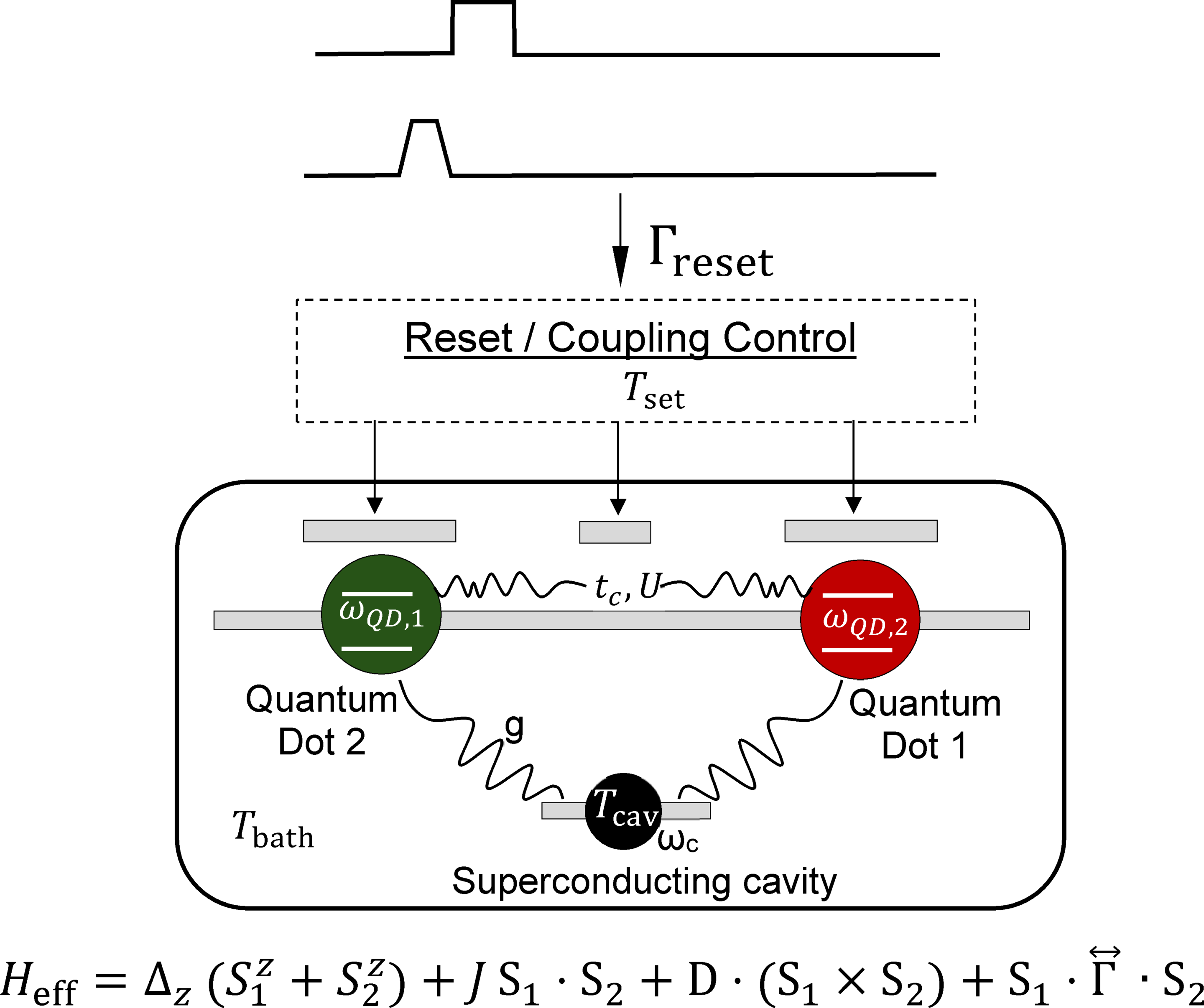
These papers primarily explore double quantum dots (DQDs), which are two quantum dots that are closely coupled by quantum correlations. Quantum dots are nanoscale regions of semiconductor material that can confine electrons in all three dimensions, giving them discrete, atom-like energy levels.
“Think of a double quantum dot like a controllable artificial atom. We can control the double quantum dot’s properties via electrical gates,” said Vashaee.
As outlined in the first paper, Vashaee used gate voltages with repeated microwave pulses. Using this method, the surrounding temperature could be 1° Kelvin or higher, while the electrons inside the double quantum dot can be cooled down below 10° millikelvin.
“Our research showed that we can actively cool the electrons inside the double quantum dot,” said Vashaee. “The electrons inside the double quantum dot then absorb very specific phonons – the same vibrations that create noise and cause qubits to lose information. So as long as we keep the electron temperature low, we’re good.”

The second paper provided proof of concept.
“Once we realized that we could cool the double quantum dot itself, the next question was, can it cool something else? So we looked into cooling a microwave cavity (not just a DQD itself, but a three dimensional space), conceptually, in the second paper. We showed that, basically, double quantum dots can act as a quantum refrigerator for 3D cavities," said Vashaee.
First, the cooled double quantum dot interacts with the warm cavity; allowing it to absorb heat from the cavity. Then the interaction is turned off. After separation, the DQD is “reset” to cool it back down, and the process repeats itself. Cool, touch, heat up, separate and cool back down again. Like a tiny heat pump, but operating under quantum rules, and requiring much less energy than existing cooling methods. Conceptually, Vashaee and his team were able to crack the problem – this solution could be used to cool a quantum computer’s qubit chip.
But NC State’s motto isn’t just “Think”. It’s “Think and Do”.
“In the third paper, we took it further,” said Vashaee. “Instead of treating the double quantum dot as a quantum object, we treated it as an engineered reservoir, something that you can deliberately design. You can tune it and optimize it using gate voltages.”
Vashaee and his team didn’t stop at theory. They found a sweet spot where cooling is most efficient. They figured out that the double quantum dot’s “reset” needs to be fast, otherwise the DQD has a sort of “residual memory” of the heat, which inhibits the cooling process. They distributed the cooled down double quantum dots in a type of “lattice” amongst the qubits.
Big picture? Vashaee and his research team figured out how to place tiny refrigerators next to each qubit, filtering out harmful phonons and preserving the fragile quantum states that electrons exist in, paving the way for on-chip refrigeration and the scalability of quantum computing.
The Hurricane
Remember, heat is vibration. Vashaee and his team have not created a true method of “cooling” as we think of it in the traditional sense, where a refrigeration system extracts heat to create cold. What they have done is managed to create tiny little “sponges” that absorb vibrations. The end goal, and what Vashaee and his fellow researchers are hoping to make a reality?
No vibrations, no heat, no loss of computation, no giant refrigerators, no roadblocks to quantum computing scalability.
“I teach a course on the physics and operations of qubits. When students are first learning, to help explain all of this, I give them an example: ‘It’s like hearing a whisper in a hurricane. Cooling turns that hurricane into a quiet room.’”
– Daryoosh Vashaee