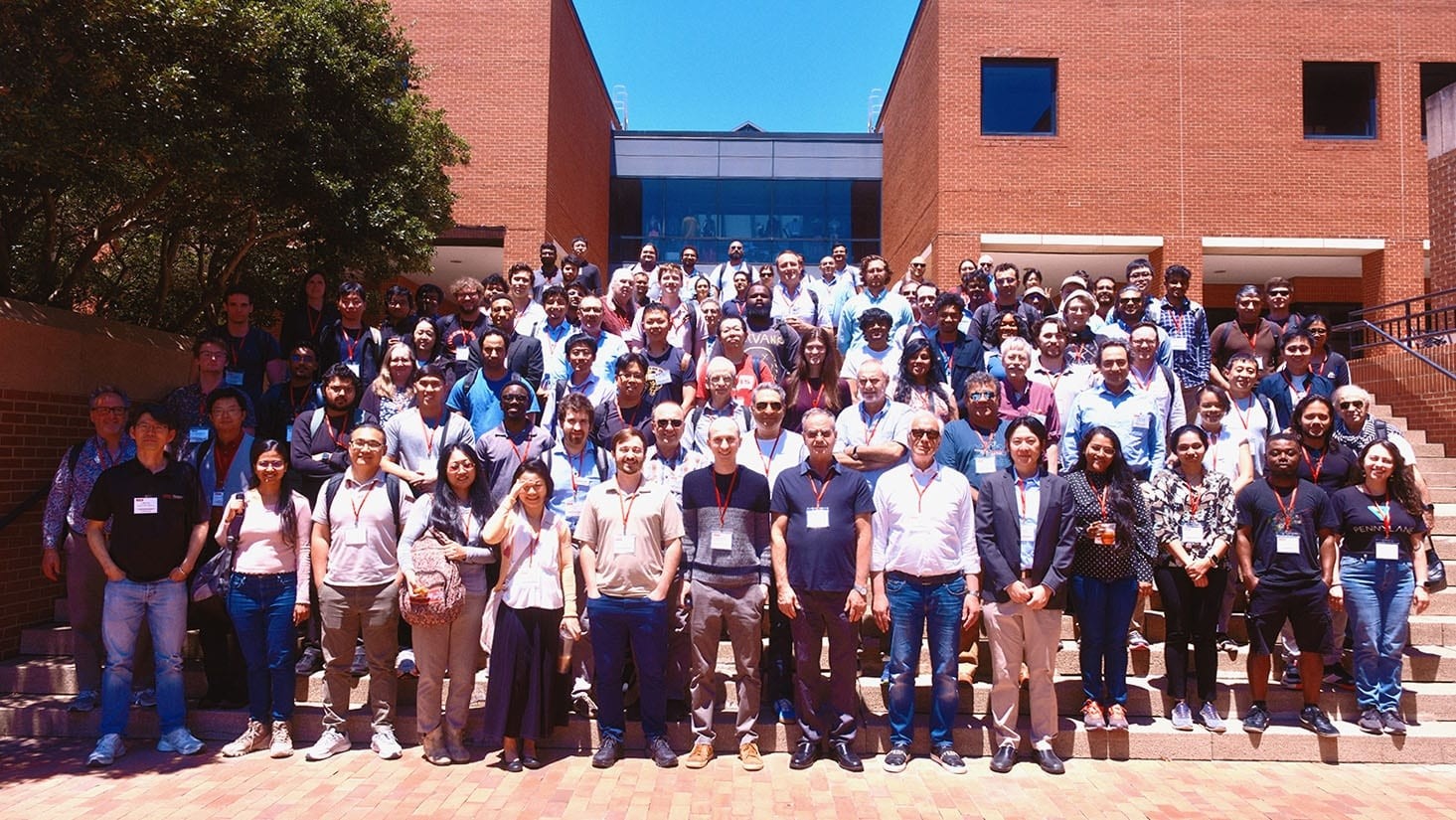
Industry professionals, students, faculty and researchers explored the future of quantum machine learning during summer school at NC State.
NC State University served as home base for 150 leading and emerging quantum researchers and industry professionals during the first Summer Workshop on Quantum Machine Learning for Complex Science and Engineering Problems, held June 1–5.
Hosted by the NC State Quantum Initiative, this five-day intensive program explored foundational aspects and advanced hybrid quantum-classical methods for solving real-world challenges in materials, chemistry, pharmaceuticals and engineering.
The workshop emphasized the intersection of quantum computing and machine learning, known as quantum machine learning, that is reshaping scientific discovery and engineering breakthroughs. North Carolina-based companies SAS and MCNC, as well as the U.S. Department of Energy’s Office of Basic Energy Sciences, supported the workshop.
Sabre Kais, the Goodnight Distinguished Chair in Quantum Computing and chair of the workshop’s organizing committee, shares hiskey takeaways from the workshop.

- Quantum machine learning is not just a theoretical subject.
University and industry researchers are already demonstrating how quantum computing can be applied to chemistry, materials design, healthcare and optimization problems that have significant societal impact. This was highlighted throughout the workshop by a series of outstanding tutorials that showcased both the fundamental principles and emerging real-world applications of quantum computing.
At the workshop, we heard about how IBM and D-Wave are designing new materials for energy storage and quantum technologies, how NVIDIA and Moderna are accelerating drug-discovery pipelines, and how Yale, the University of Chicago and others are predicting molecular and chemical properties with quantum methods. This is speeding up discovery. With quantum, you can do more with less.
Compared to classical computing, quantum computing has the potential, in principle, to perform large-scale classification tasks using significantly more compact representations and computational resources, enabling complex problems to be addressed at a much smaller scale.
Hsin-Yuan (Robert) Huang, CTO at Oratomic and assistant professor of theoretical physics at the California Institute of Technology, shared an important contribution of quantum machine learning. His team’s recent paper, “Exponential quantum advantage in processing massive classical data,” shows theoretical justification that using quantum offers a distinct advantage in manipulating certain data over classical computing.
Using examples ranging from single-cell RNA sequencing to movie review analysis, the work demonstrates how quantum models can perform large scale classification using dramatically more compact representations, highlighting the transformative potential of quantum computing for data intensive applications.

- NC State is uniquely positioned to train a quantum workforce.
NC State is making investments in quantum science and engineering through the NC State Quantum Initiative, which brings together researchers across engineering and science disciplines. We have more than 20 groups at NC State involved in quantum computing. We have faculty teaching courses in quantum computing, quantum information, quantum sensing, open quantum dynamics, hardware and more across the Colleges of Sciences and Engineering.
With our university’s strengths in engineering, semiconductors, computer science, artificial intelligence and data science, we are able to develop interdisciplinary coursework, graduate programs and professional development opportunities that prepare students for careers in quantum computing and quantum information science. We are working on developing a quantum certificate and a quantum master’s degree program.

- Building practical quantum technologies requires strong partnerships among universities, industry and government laboratories.
Our workshop brought together speakers and participants from major technology companies, startups, national laboratories and leading universities. Representatives from industry, federal laboratories and academic institutions shared perspectives on both current capabilities and future challenges in quantum computing.
NC State’s proximity to Research Triangle Park promotes partnerships with a growing ecosystem of technology companies, startups, national laboratories and research institutions working in quantum technologies.


- Practical and hands-on experience with quantum programming platforms is more accessible than people realize.
Each day of our workshop featured hands-on activities. Participants gained direct experience with quantum programming platforms and emerging quantum hardware through tutorials and hands-on sessions led by experts from industry and academia. These skills are critical to advancing quantum computing and growing our workforce.
During these sessions, students, researchers and industry representatives learned how to:
- Design quantum algorithms using PennyLane and other open-source platforms.
- Build quantum machine learning models.
- Implement hybrid quantum-classical algorithms.
- Access cloud-based quantum computing platforms.
- Explore applications in chemistry, optimization and artificial intelligence.
- Evaluate the strengths and limitations of current quantum devices.
- AI and quantum computing will push each other’s growth.
Many people are using AI to try to come up with a better design for future quantum computers and to design a new generation of quantum algorithms. Right now, it leans more toward classical AI being used to advance quantum rather than quantum for AI, because we don’t have a big enough quantum machine to support this. But quantum is going to help advance AI once we have a fault-tolerant computer capable of real-time error correction. People in hardware say we’re five to 10 years away from this, but as we have more of interest from science and engineering, the government and industry are pushing this explosion. You have now hundreds of people working the beat.
This is going to be really a frontier in the field, along with advancing quantum machine learning from theoretical concepts to application. Industry wants to use quantum machine learning for optimization in drug discovery and other practical applications. So, I think pushing quantum machine learning from theoretical concept to application is going to be the frontier now. We’re still working on the foundation of quantum machine learning, how to come up with theoretical concepts, like how scaling works, how it works on different platforms, but at the same time, we’re working toward applying this to solving real-world problems.