

News
Keep posted on what our department and its members are accomplishing on a daily basis.Announcing the 2026-27 Global One Health Fellows
Posted on April 14, 2026 | Filed Under: News
Yi Chen Yi Chen is a fourth year PhD student in Electrical Engineering developing miniaturized, noninvasive, and scalable wearable sensor platforms for humans, plants, and animals that enable continuous monitoring…
New Technique Improves Accuracy of Graph Neural Networks
Posted on April 13, 2026 | Filed Under: News
Researchers have demonstrated a new training technique that significantly improves the accuracy of graph neural networks – AI systems used in applications from drug discovery to weather forecasting.

How an Injectable Particle Could Make Surgery Safer for Infants
Posted on April 3, 2026 | Filed Under: News
Researchers have designed an injectable microgel to reduce bleeding in infants who require surgical care. In an animal model, the microgel reduced bleeding by at least 50%.

Lenovo Investment Advances NC State’s Esports Program, Recognized with Arena and Gaming Lab Naming
Posted on April 2, 2026 | Filed Under: News
Game on: A naming-level gift from technology giant Lenovo will bolster the growing momentum and profile of NC State’s program in esports. Lenovo’s transformational commitment includes substantial financial support for both an endowment …

New Sensors Lower the Cost of Studying Genetic Disorders
Posted on April 2, 2026 | Filed Under: News
Researchers have demonstrated a new class of low-cost, scalable sensors that can be used to monitor electrical activity in human cerebral organoids.

See You on the Dark Side of the Moon
Posted on April 1, 2026 | Filed Under: News
Three-time NC State graduate Christina Koch and her three Artemis II crewmates will blast off to the moon as early as Wednesday evening.

From the Brickyard to the Moon: Christina Koch Through the Years
Posted on April 1, 2026 | Filed Under: News
Ahead of her moon-bound NASA mission, explore a timeline of Christina Koch’s life and career.

The Right Stuff
Posted on March 31, 2026 | Filed Under: News
In 2016, NC State magazine profiled Christina Hammock Koch ’01, ’02 MS as she had been named to NASA’s 21st class of astronauts. Revisit her story as this week she joins the Artemis II mission, NASA’s first trip to the moon in o …
Grad Students Build Bridges for Agricultural Innovation
Posted on March 27, 2026 | Filed Under: News
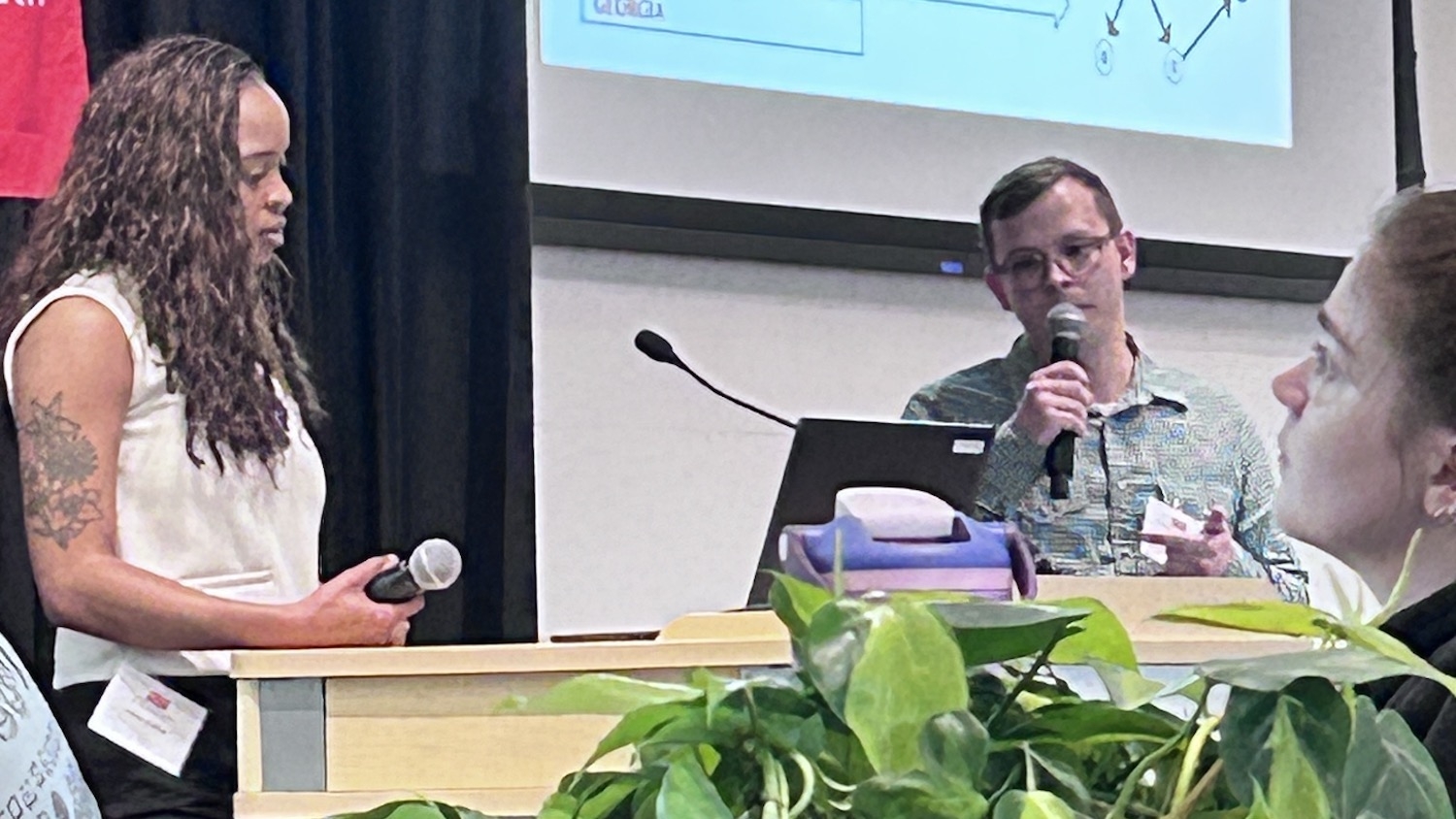
The N.C. PSI’s BRIDGE Symposium provided a window into the bold ways graduate students are collaborating across academic fields to solve a range of agricultural challenges.

Leading the Pack in Robotics at NC State
Posted on March 23, 2026 | Filed Under: News
At NC State’s first annual Robotics Symposium, faculty envision the College of Engineering at the forefront of a rapidly growing field.

These ‘Cyborg Insects’ Could Become the World’s Stealthiest Spies—Because They Hide Where Humans Can’t
Imagine a war zone where swarms of cockroaches equipped with miniature backpacks sneak across front lines to spy on enemies. It might sound like a scene from a horror movie, but experiments to accomplish exactly that are underway. SWARM Biotactics, a German company founded in 2024, aims to create “bio-robotic swarms” for military use.
Posted on April 21, 2026

NCSU students add sensors, weather station to whirligigs
N.C. State engineering students are expanding sensor monitoring and adding a real-time weather station at Vollis Simpson Whirligig Park to better track wear on the park’s kinetic sculptures.
Posted on April 19, 2026

Not your average bandage. This NC State invention requires electricity to heal
Currents of electricity flowing through the body are often associated with bad things like electrocution. However, that power can be beneficial when treating chronic wounds or injuries that struggle to heal on their own.
Posted on June 26, 2025

Case Study: How TPUXtract Leveraged Keysight Tools for AI Model Extraction
Artificial Intelligence (AI) is at the heart of modern computing, driving advancements in industries ranging from autonomous systems to enterprise security. However, as AI models become more sophisticated, so do the threats targeting them.
A team of researchers at North Carolina State University (NCSU) recently demonstrated a new technique for extracting AI models from hardware accelerators using electro-magnetic side-channel analysis (SCA). This article explores their findings and highlights how Keysight’s Side-Channel Analysis tools aided in validating and executing their attack.
Posted on March 19, 2025
Whirligigs and Innovation: NC State Engineering Students Bring Science to the Park


Posted on February 26, 2025
NC State engineering students monitor wind at Whirligig Park
North Carolina State University engineering students will place sensors on one of the whirligigs at Vollis Simpson Whirligig Park to study the source of wind that powers the structure and to see how efficiently the whirligig is moving.
On Wednesday, the students met with the conservationists who spent years restoring the kinetic sculptures after they were disassembled from Simpson’s Lucama farm and before they were installed at the downtown Wilson park.
“For this project, our main goal is to be able to provide a network of sensors that can give a data set that can be used in the museum for educational purposes and provide some sort of rudimentary risk analysis system for the conservation teams so they can know if there is a whirligig that needs to be looked at,” said Connor Raines, an electrical engineering student at N.C. State.
The experimental sensors will be mounted on BBB Blue Star, which was one of the first whirligigs to be placed in the park.
At 35-feet, BBB Blue Star is one of the largest whirligigs in the park and has 6-inch reflectors on its fan and vane.
“That is the best turning one out there,” said conservationist Joe Justice.
The whirligig is located near the southwest side of the park, which is about 300 feet from the left field fence, and will be about 700 feet from home plate at the new baseball stadium being constructed at the corner of Goldsboro and Hines streets
One sensor will measure tilt, while another measures vibration.
A third will be mounted near the hub that rotates in the wind.
“It will have magnets mounted on the inside,” Raines said. “The sensors detect magnetic fields, so we will be counting how many times the magnetic field changes to estimate the rotation speed.”
Data from the sensors will be transmitted by radio to a “gateway” that will send the information to a computer in the Vollis Simpson Whirligig Park Museum and Gift Shop, located across Goldsboro Street from the park.
Raines said the system could eventually be used for a rudimentary risk analysis.
“If it is vibrating out of bounds, we can send a ping message somewhere to say, maybe something is off-balance,” Raines said.
Student Thomas Van said the sensors run off common AA batteries.
“They are running off of microcontrollers that have been preprogrammed because they are industrial sensors,” Van said. “We didn’t build these ourselves or anything, but they meet our specifications.” The indicator may tell conservationists that the whirligig needs to be examined.
“We are witnesses of the birthing of a new whirligig technology,” said Joe Justice, one of the three conservationists who met with the students.
Data gathered by the sensors will be presented on the Whirligig Park website and be accessible to the general public.
“It is certainly going to reach out to a group of people that might not otherwise be interested,” Justice said.
Roy Palmer, executive director for the park, said BBB Blue Star is going to be the most immediately affected by the construction of the new baseball stadium next to the park because of its location.
“What we are going to have is about eight months until the stadium is finished,” Palmer said. “We’ll have the data set for those eight months. Once the stadium complex is together, we should be able to see how that has affected them.”
The stadium is just one piece of the puzzle, and it wasn’t the driving force for this project. The recent demolition of Farmers Warehouse changed the wind pattern at the park, he said.
Wilson-based Bartlett Engineering & Surveying is a project sponsor.
David Via, a project engineer from Bartlett Engineering and Surveying, is on the board of the Vollis Simpson Whirligig Park.
Other N.C. State students participating include computer engineering students Mario Rosas and Jackson Toburen.
The team will first be working on design for mounting brackets using whirligigs at N.C. State as models.
“We will also be doing a lot of tests simulating the whirligigs at N.C. State just to make sure we know the full capabilities of these sensors before we put them 30 feet in the air,” Raines said. “We plan to have it on BBB Bluestar before May.”
Conservationist Mel Bowen said the sensors will have an opportunity to take baseline measurements before the stadium gets to a point in construction that it will affect the wind moving through the whirligig park.
Posted on February 6, 2025