
Students Use Data Science Skills to Address USDA Ag Challenges
As USDA interns, five NC State graduate students applied data science skills to help build AI tools for agriculture.
January 5, 2026  Dee Shore
Five North Carolina State University graduate students used their data science and computer technology skills to help address agricultural challenges facing American farmers.
As part of the U.S. Department of Agriculture Agricultural Research Service’s Artificial Intelligence Center of Excellence and SCINet Graduate Student Internships Program, each student was paired with a USDA-ARS scientist mentor for 10 weeks, engaging in high-impact agricultural research. The internship program returns this summer, with eight slots available for NC State students.
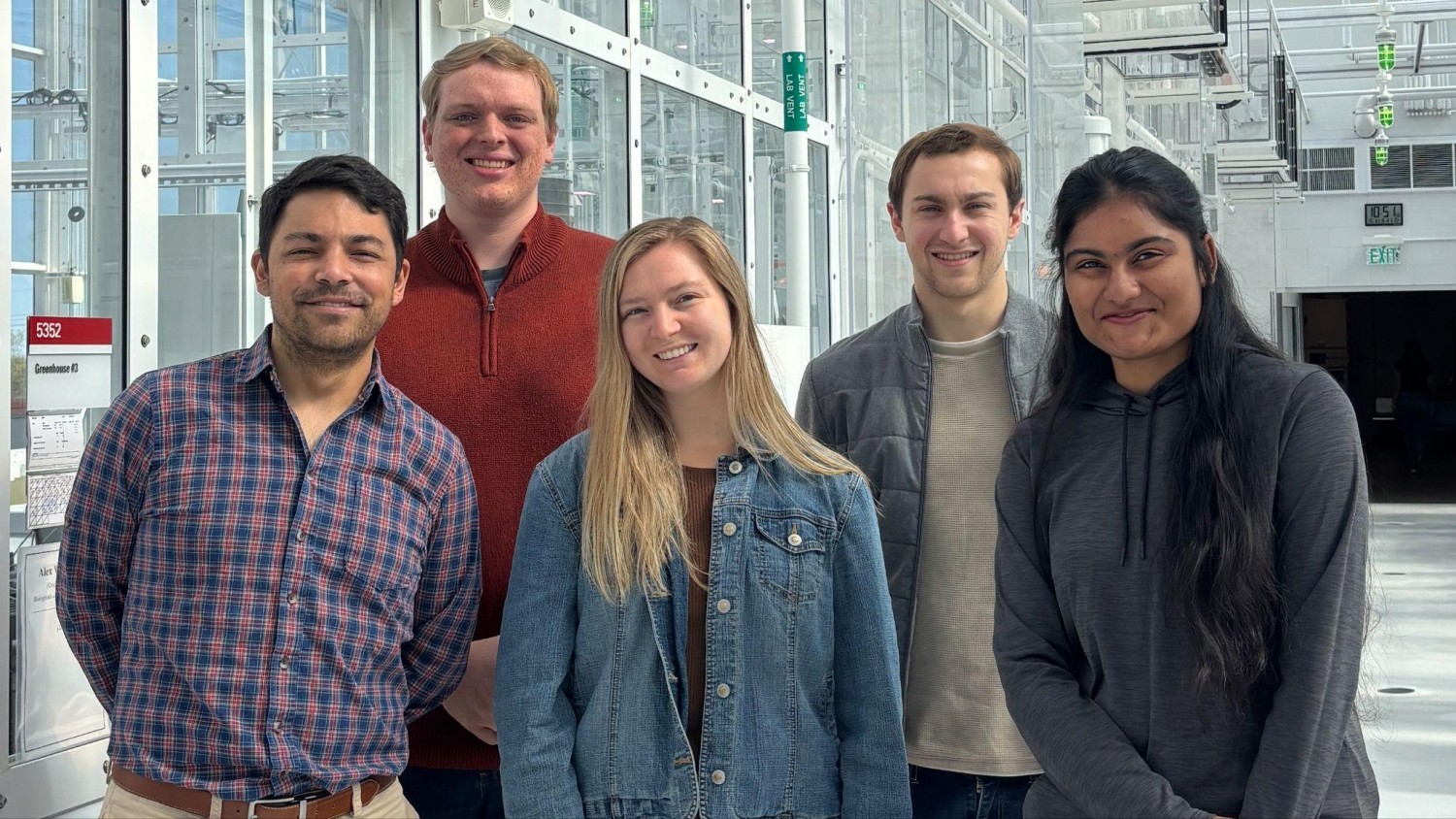
Loevan Bost, Camilo Zuluaga, Delaney Dow, Jaya Shruti Chintalapati and Nicholas Brunsink were among 15 interns nationally to participate in the program in 2025.
Such immersive experiences allow students to gain professional skills, build their personal networks and increase their understanding of possible career paths.
Each of the NC State interns were engaged in computer vision projects. In computer vision, developers use images to teach computers to see and understand the world. Computer vision offers opportunities to provide farmers with real-time insights that allow them to increase productivity, reduce costs and increase their sustainability.
Terri Long, head of NC State’s Department of Plant and Microbial Biology and former N.C. Plant Sciences Initiative platform director for education and workforce development, said the internships prepare students to tackle the kinds of challenges they’ll face in their careers.
“Such immersive experiences allow students to gain professional skills, build their personal networks and increase their understanding of possible career paths,” she said. “In some cases, students are able to publish their work, and some even receive job offers to continue working with USDA-ARS after the completion of the internship.”
The internships were funded and coordinated by USDA-ARS’s AI Center of Excellence and SCINet programs. Long administered the NC State students’ internships, with support from Sarah Dinger, the N.C. PSI program manager for education and outreach, and Susan Wassmer, NC State Extension business manager.
The agricultural challenges the interns addressed ranged widely — from preventing soil erosion to detecting prion diseases in livestock.
Loevan Bost: Building Better Tools to Predict Soil Erosion
Loevan Bost spent his summer working with Chris Renschler, a supervisory soil scientist and research leader at the USDA-ARS National Soil Erosion Research Laboratory in West Lafayette, Indiana. Renschler is working on a project to allow farmers and land managers to use close-range cellphone photos they take in their fields to better predict erosion and runoff patterns.
It was rewarding to see how my work with AI and data analysis could contribute to solving real problems in agriculture.
Bost is a master’s student studying computer networking in NC State’s Department of Electrical and Computer Engineering. With Renschler, he dug into the challenges involved in using digital photos based on the standard RGB color model to train computers to identify and map different types of ground surfaces — bare soil versus erosion protective new crop and past-year crop residues — especially in places where detailed information is not available.
The dataset Bost came up with improved the performance of the machine learning model, an important step toward providing farmers with data-driven information about the impact spring rainfall has on soil, nutrient and seedling losses at both the field- and farm-scale.
For Bost, the experience was a chance to expand his skills in AI and computational tools and gain hands-on experience with high-performance computing.
“I was able to develop technical skills in areas I had little knowledge of, and I gained valuable exposure to agricultural research,” Bost said. “It was rewarding to see how my work with AI and data analysis could contribute to solving real problems in agriculture.”
The internship aligned perfectly with Bost’s career goal: As a software or AI engineer, he wants to solve problems that have real-world impact in industry and government.
Camilo Zuluaga: Making Crop Monitoring More Precise and Less Costly
Like Bost, Camilo Zuluaga was tasked with training a machine learning model using images. In Zuluaga’s case, the goal was to give farmers better ways to monitor their crops.
His mentor was Paul Adler, an agronomist who works at the USDA-ARS Pasture Systems & Watershed Management Research Unit in University Park, Pennsylvania.
I had to put all my effort into learning about topics that were new to me, but I also was able to apply knowledge that I acquired in the previous semester in both optics and machine learning.
“In precision farming, it is common to use multispectral images to monitor crop health, biomass and several vegetation indices,” Zuluaga said “I trained a machine learning model that combines RGB drone images and satellite images to create high-resolution multispectral images. It allows farmers and researchers to get the images at a fraction of the cost.”
Zuluaga is a master’s student in electrical engineering who works in the Optical Sensing Lab run by Mike Kudenov, an N.C. PSI faculty affiliate.
He called his internship “amazing.”
“From the beginning I had to put all my effort into learning about topics that were new to me, but I also was able to apply knowledge that I acquired in the previous semester in both optics and machine learning, as well as my experience working in the Optical Sensing Lab with Dr. Kudenov,” he said. “It is great to connect the dots and feel that all those study nights along the semester were worthwhile.”
Zuluaga hopes to continue working in the computer vision field after he graduates, using it to make this world a better place.
“It could be in robotics, agtech or other sectors where my effort could positively affect millions of lives,” he said.
Delaney Dow: A Pipeline for Faster, More Accurate Prion Disease Detection
Another student working in Kudenov’s Optical Sensing Lab, Delaney Dow, spent the summer working on better ways to detect prion diseases in livestock.
Dow is a master’s student in electrical engineering, and she interned with research veterinary medical officer David Schneider of the USDA-ARS Animal Disease Research Unit in Pullman, Washington.
Prion diseases are neurodegenerative diseases caused by misfolded prion proteins that accumulate in the brain and cause progressive neurological damage. Examples are scrapie in sheep, bovine spongiform encephalopathy in cattle and chronic wasting disease in deer and elk.
Dow contributed to Schneider’s efforts to develop a machine learning algorithm to quickly and accurately detect the diseases.
The project's goal, Dow said, was to create an automated system that analyzes thousands of digital images of tissue from livestock.
I got to work with an incredible mentor who was willing to help me learn, while also instilling independence in me to take direction over some of the project parameters.
As Schneider explained, "This effort is critical because there are no treatments for prion disease — which are always fatal — and because chronic wasting disease is spreading unchecked across North America. Also, the massive workload of surveillance for these diseases has been placed on a limited number of highly trained veterinary pathologists."
The system is designed to help pathologists process samples faster. The algorithm provides a prediction on whether a tissue sample contains prion disease, and these results are then sent to a specialized software that pathologists already use.
“This approach helps to augment their current work, allowing them to sort through a massive volume of slides more efficiently and focus their expertise on the most critical cases,” Dow said. “The outcome is a faster, more accurate screening process that protects both animal and public health.”
Dow’s time with the USDA should give her an edge as she pursues her career goal, working in industry to develop medical imaging techniques and improve clinical outcomes by using artificial intelligence and machine learning.
“I got to work with an incredible mentor who was willing to help me learn, while also instilling independence in me to take direction over some of the project parameters,” she said.
Jaya Shruti Chintalapati: Estimation of Quality Parameters for Poultry Products
Like the other USDA interns from NC State, Jaya Shruti Chintalapati found it rewarding to contribute to research aimed at making a difference for farmers and consumers.
Chintalapati is pursuing a master’s degree focused on the data science track in computer science, with the goal of becoming an applied scientist who develops and deploys advanced AI methods.
“I aspire to work at the intersection of data science and AI, translating cutting-edge research into practical solutions that drive innovation, improve decision-making, and create real-world impact,” she says.
Chintalapati found that her internship with Seung-Chul Yoon aligned very closely with those goals. Yoon is a research electronics engineer with the USDA-ARS U.S. National Poultry Research Center in Atlanta.
As Chintalapati explained, “This is important for food safety and quality, since even tiny fragments can pose health and regulatory risk. I implemented masking of hyper-spectral images of chicken fillets, incorporating a much larger dataset.”
She also implemented a CNN, or convolutional neural network, which can better capture the complex patterns in the data and improve detection accuracy. “I would like to work more on the project to implement vision transformers into it,” she said.
The mentorship, collaboration and exposure to USDA research broadened my perspective and helped me grow as both a researcher and problem-solver.
Chintalapati found working with large hyperspectral imaging datasets both rewarding and challenging.
“It challenged me to refine my technical skills in machine learning and high-performance computing, while also learning to adapt AI methods to complex, applied problems. The mentorship, collaboration and exposure to USDA research broadened my perspective and helped me grow as both a researcher and problem-solver,” she said.
Nicholas Brunsink: Quick Quantification of a Destructive Plant Disease
Nicholas Brunsink, a second-year Ph.D. student in electrical and computer engineering, spent his summer interning with the USDA-ARS Floral and Nursery Plants Research Unit in Beltsville, Maryland. There, he worked with research geneticist Jinyoung Barnaby on a project related to dollar spot, the most common and economically destructive turfgrass disease in the United States.
Current management practices rely on preventative fungicide applications, often regardless of disease pressure. Barnaby’s team aims to provide turf managers and breeders with the knowledge to use fungicides with greater precision and only when needed.
Computer vision is able to quickly and accurately quantify disease symptoms, but large training datasets are scarce due to their difficulty to make.
As Brunsink explained, traditional methods to quantify disease are subjective and time-consuming, making it difficult to obtain consistent results at a large scale. “Computer vision is able to quickly and accurately quantify disease symptoms, but large training datasets are scarce due to their difficulty to make,” he said.
To address this, Brunsink helped develop a user-friendly software tool with a graphical interface. The tool streamlines dataset creation, automatically identifying and isolating diseased areas in images and allowing experts to quickly confirm or adjust the annotations.
The tool decreases the time to create a single training image, out of hundreds or thousands, from 30 to 60 minutes down to one to two minutes, while also improving accuracy, he said. It also supports custom segmentation settings to enable a wide range of applications beyond turfgrass.
As his mentor, Barnaby, noted, “By bridging expert insight with automation, this effort delivers a novel platform that not only transforms how plant disease datasets are built but also sets the groundwork for broader AI-driven discovery across agriculture.”